Published · Updated
The quick answer
- Oral terbinafine (prescription) has the strongest published cure rates, at the cost of a prescription, roughly twelve weeks of tablets, and possible liver monitoring.
- Prescription and OTC topicals suit new, thin, mild cases but need near-daily use for months.
- In-clinic laser needs no daily effort but costs $300–$1,200+ per course and is rarely covered by insurance.
- At-home light therapy like FungaBeam is the lowest-cost, prescription-free option, provided you will do a short daily session for several months.
Strongest evidence: oral terbinafine
If you want the option with the best published cure rates and no reason to avoid systemic medication, this is it. A doctor typically prescribes daily tablets for around twelve weeks, sometimes with a baseline liver-function blood test and a follow-up check partway through. It is the option most likely to be recommended first by a dermatologist for a confirmed, moderate-to-severe infection.
The trade-offs are real: it requires an appointment and a prescription, it is a systemic medication so it interacts with some other drugs and is not suitable for everyone with liver conditions, and even after a successful course the nail still needs months to grow out clear. Cost varies by insurance and pharmacy but is usually modest compared with clinic procedures once a prescription is covered.
Best for mild, surface-level cases: medicated topicals
Prescription lacquers such as amorolfine and ciclopirox, and over-the-counter antifungal creams or tolnaftate solutions, are worth trying when the infection is new, affects a small part of the nail, and the plate is not yet thickened. They are inexpensive and low-risk, and can be applied at home without monitoring.
The catch is penetration. The nail plate is dense keratin, and topicals applied to its surface struggle to reach the infection underneath in anything but the thinnest, most superficial cases. Expect daily or near-daily application for the better part of a year, and file the nail thin regularly so the product actually has a route through.
Fastest supervised option: in-clinic laser
A course of podiatry laser sessions is professionally supervised and needs no daily effort from you between appointments. It also typically costs several hundred to well over a thousand dollars for a full course, is rarely covered by insurance, which usually classifies it as cosmetic, and — like every other option here — still requires the damaged nail to grow out afterwards rather than repairing instantly.
It suits people for whom cost is not the deciding factor and who would rather outsource the daily discipline to a clinic schedule than manage it themselves at home.
Best value for daily self-treatment: at-home light therapy
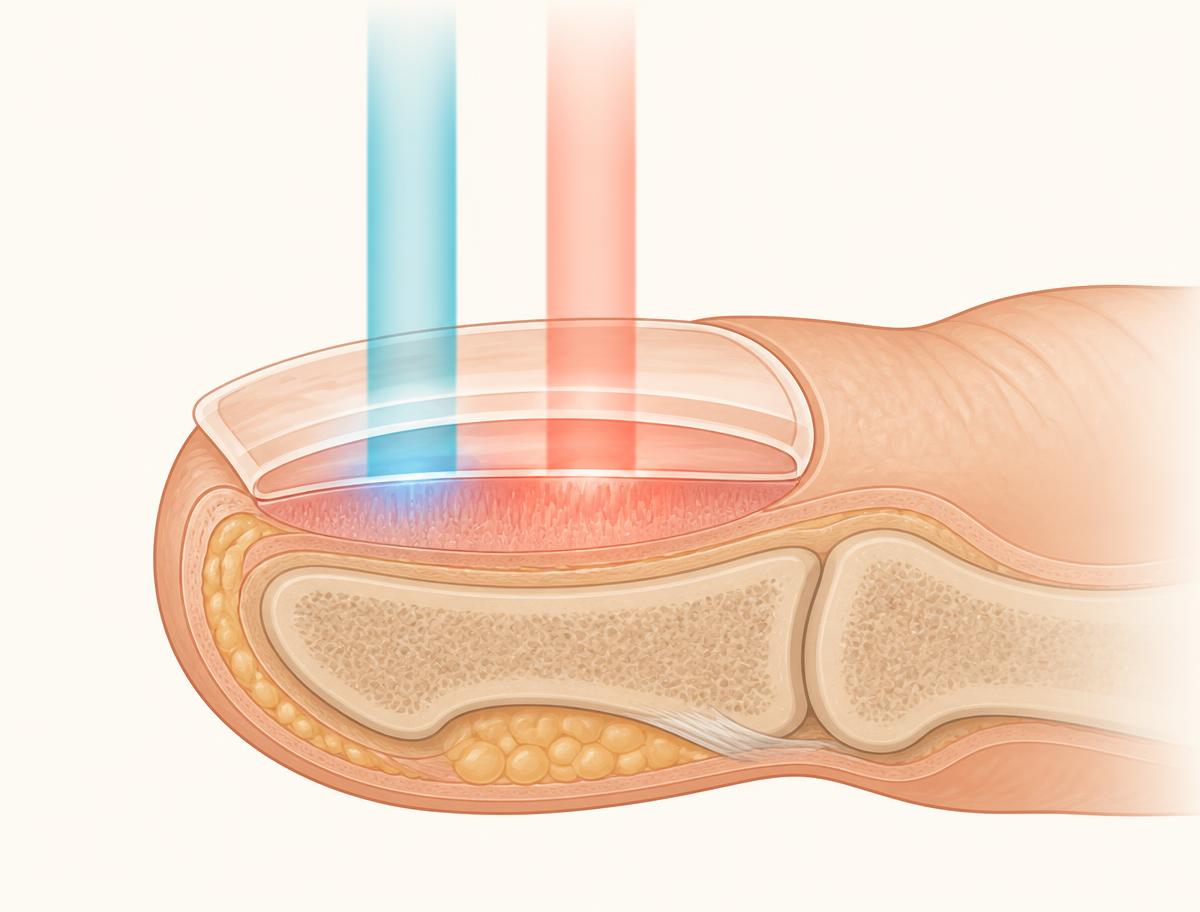
A one-off purchase, no prescription, no appointments, no drug interactions to worry about. The trade-off is entirely on you: a short session every day for months, rather than a supervised course someone else manages. FungaBeam is $34.99 to $49.99 per device depending on pack size, with free tracked shipping and a 30-day money-back guarantee if the routine is not for you.
This route suits people who want to start tonight rather than book an appointment, who are not medically suited to or interested in oral medication, and who are realistic about the fact that any nail treatment, including this one, takes months to show in the nail itself.
The lowest-friction option
One-off cost under $50, no prescription, 90 seconds a day, 30-day money-back guarantee.
- From $34.99 per device
- Free tracked shipping
- 30-day money-back
“I have been using FungaBeam since January. My case has cleared up and my nails look great.” — Patricia L., Ohio, US
Worth trying, low expectations: home remedies
Vicks VapoRub, tea tree oil, vinegar soaks and Listerine foot soaks are cheap and mostly harmless, and a minority of very mild cases seem to improve with them. All of them share the same fundamental problem as topicals: getting an active ingredient past the nail plate in a concentration that actually matters.
If you try one, give it twelve consistent weeks and judge it the same way you would any other treatment — by the new growth at the base of the nail, not by the discoloured tip that was already damaged before you started.
Comparing all five options side by side
Reading this table honestly: cost and supervision run in roughly opposite directions from convenience and daily control. There is no option that is cheap, fast, supervised and effort-free all at once — every route asks you to trade something.
| Option | Typical cost | Time commitment | Prescription? | Realistic outcome |
|---|---|---|---|---|
| Oral terbinafine | Rx + pharmacy cost, ~12 weeks | Daily tablet, ~12 weeks | Yes | Strongest published cure rates for suitable patients |
| Topical lacquers/creams | $15–$80+, months of use | Daily application + filing | Some Rx, some OTC | Works best on new, thin, mild infections |
| In-clinic laser | $300–$1,200+ per course | 3–4 appointments | No | No daily effort; nail still grows out slowly |
| At-home light therapy (FungaBeam) | $34.99–$49.99 one-off | 90 seconds daily, months | No | Drug-free, self-managed, needs consistency |
| Home remedies | Under $20 | Daily, indefinite | No | Mild cases only, unreliable |
What people get wrong when choosing
The most common mistake is picking based on price alone and ignoring the effort required to actually finish the course. A $15 cream you stop using after three weeks is worse value than a $40 device you use every day for four months, because only the second one has any chance of working.
The second mistake is switching treatments every few weeks looking for a faster result. Nails grow slowly regardless of what treats the infection, so switching resets your visual progress marker (the clear band at the base) without changing the underlying biology. Pick one route and commit to it for at least three months before judging it.
How to choose in sixty seconds
- Diabetes, circulation problems or a painful nail — see a clinician first, always.
- New, small, thin nail involvement — start with a topical plus regular filing.
- Thick, long-standing, several nails, and you want the best odds regardless of cost — ask a doctor about oral terbinafine.
- You want drug-free and will commit to a daily routine — at-home light therapy.
- Budget is not a constraint and you want it handled for you — clinic laser.
Frequently asked questions
Ready to start treating the nail bed tonight?
Whichever route fits your case, pick one and give it a real run of several months rather than switching every few weeks — that switching is the single biggest reason people conclude nothing works.
- From $34.99 per device
- Free tracked shipping
- 30-day money-back
“I have been using FungaBeam since January. My case has cleared up and my nails look great.” — Patricia L., Ohio, US
Keep reading
- FungaBeam reviewWhat the device is, how it is used, and an honest account of who it suits.
- Terbinafine and LamisilThe prescription standard: how it works, success rates, side effects and monitoring.
- Does laser work?What the evidence supports, and how clinic lasers differ from at-home light devices.
- Best treatment by situationMild, moderate, severe or recurring — matched to the right treatment for each.
Sources
This page is general information, not medical advice. FungaBeam is a consumer wellness device and is not intended to diagnose, treat, cure or prevent any disease. Speak to a doctor or podiatrist about your own situation, particularly if you have diabetes, circulation problems or worsening symptoms.