Published · Updated
The quick answer
- Tea tree oil reliably inhibits the fungi behind toenail infections in laboratory testing, and small human trials show improved nail appearance, but confirmed full cure rates remain modest.
- It must be diluted — roughly five to ten percent in a carrier oil — because undiluted tea tree oil causes contact irritation in a meaningful number of users.
- The same barrier problem applies as with any topical: the nail plate limits how much reaches an established infection underneath.
- A fair trial is twelve weeks of correct, diluted, twice-daily use with weekly filing, judged by new growth at the base of the nail.
What it is and why people try it
Tea tree oil is steam-distilled from the leaves of Melaleuca alternifolia, an Australian native plant, and has been used topically for skin and nail complaints for decades. Unlike many home remedies, it has an actual body of laboratory and small clinical research behind it, which is part of why it is often recommended ahead of other essential oils.
People try it because it feels like a middle ground between doing nothing and going to a doctor: a natural product with some genuine science, sold in any pharmacy, without a prescription.
What the evidence actually shows
In laboratory testing, tea tree oil reliably inhibits the dermatophytes and yeasts responsible for most nail infections. Human trials in onychomycosis have been small — often a few dozen participants — but several have compared it against a topical antifungal (clotrimazole) and found broadly comparable improvement in nail appearance over several months.
The important caveat is what 'improvement' meant in those trials: it was mostly clinical appearance, not a laboratory-confirmed mycological cure in every case. As with most topicals, appearance often improves before, or without, the underlying fungus being fully eradicated — which is why relapse after stopping is common.
How to dilute it correctly
Undiluted tea tree oil is a common cause of allergic contact dermatitis, and using it neat on skin that is already compromised by a nail infection is asking for irritation. For nail use, dilute to roughly five to ten percent in a carrier oil — about one part tea tree oil to ten parts coconut, olive or jojoba oil.
Always patch test on the inside of your forearm and wait twenty-four hours before applying it near a foot you are already worried about. If any redness or itching develops at the test site, do not proceed to the nail.
How people use it
- Soak and dry the foot, then clip and file the nail as thin as comfortably possible.
- Apply two or three drops of the diluted mixture to the nail surface and under the free edge with a cotton bud.
- Work a little into the skin fold around the nail, where dermatophytes also commonly live.
- Let it absorb for a few minutes before putting on clean, dry socks.
- Repeat twice daily, every day, with weekly filing, for at least twelve weeks.
Timeline and what working looks like
In the small trials, meaningful improvement in appearance was generally reported after several months of continuous use, not weeks. Track progress by photographing the nail at the same angle every two to three weeks and watching specifically for a clear band of new nail growing out at the cuticle.
If that new growth is coming in clear while the older, damaged nail simply grows out and gets trimmed away, the treatment is doing something. If the newest growth is discoloured too, the oil is not reaching the active infection.
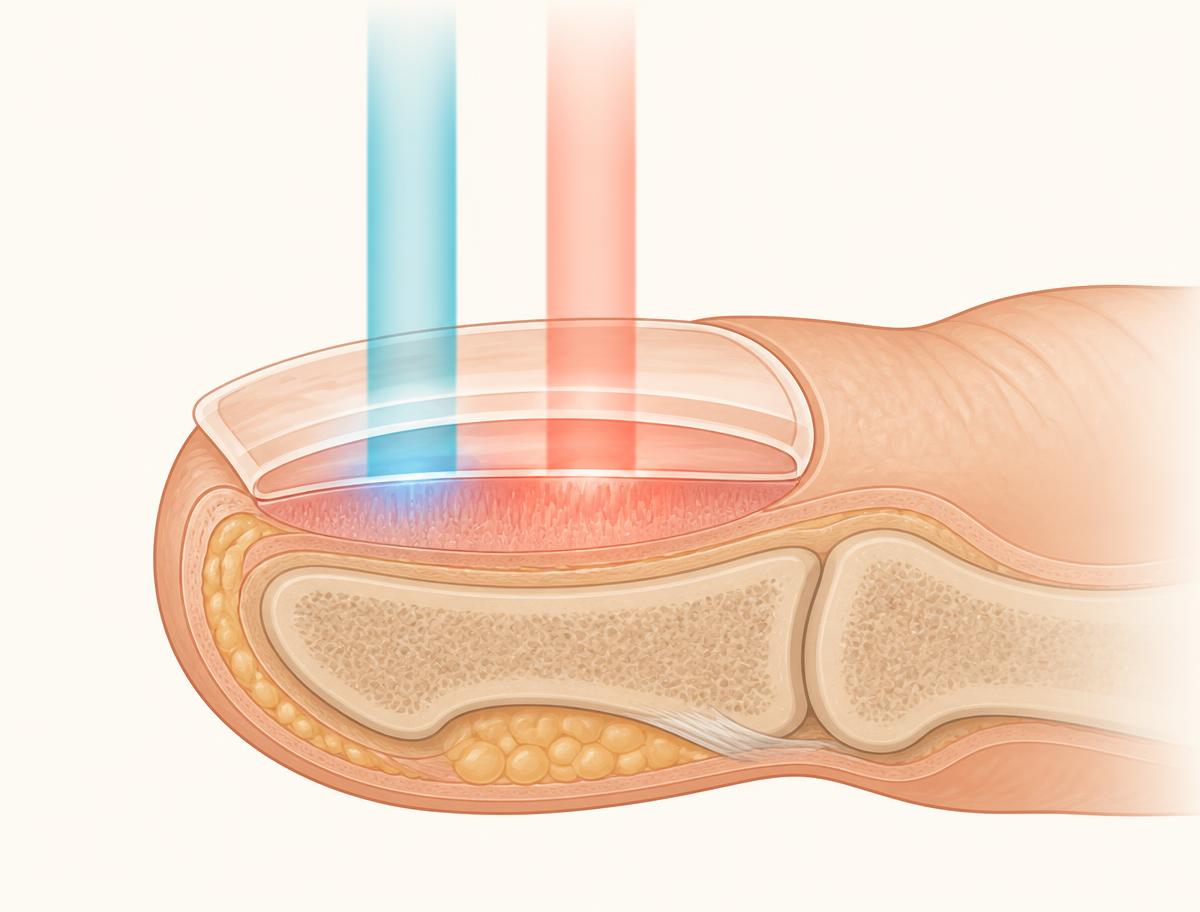
When topicals stall
Light passes through the nail plate that oils cannot penetrate. 90 seconds a day, drug-free.
- From $34.99 per device
- Free tracked shipping
- 30-day money-back
“I have been using FungaBeam since January. My case has cleared up and my nails look great.” — Patricia L., Ohio, US
Risks and who should avoid it
Do not use tea tree oil on broken or inflamed skin, and never take it internally — it is toxic if swallowed. It is also toxic to cats and dogs, so keep treated feet away from pets licking the area. Stop immediately if redness, itching or burning develops, and see a pharmacist or doctor if a reaction does not settle quickly.
Tea tree oil vs. other options
Where it sits relative to other approaches people compare it with.
| Approach | Evidence strength | Typical cost | Realistic timeline | Skin irritation risk |
|---|---|---|---|---|
| Diluted tea tree oil | Moderate — several small trials | $10–20 | 3–6 months for visible change | Moderate if used undiluted |
| Vicks VapoRub | Weak — one small pilot study | Under $10 | 3–12 months, inconsistent | Low |
| Oral terbinafine (prescription) | Strong, multiple trials | Prescription cost varies | 3-month course, up to a year to full nail | Low (systemic side effects instead) |
| Daily light therapy (e.g. FungaBeam) | Emerging, device-based | From $34.99 | 4–8 weeks to first new growth | Very low |
What to combine it with
Weekly filing is not optional — it is one of the few interventions consistently associated with better outcomes in the trials, because it physically reduces the amount of keratin the oil has to cross. Pair it with daily washing and thorough drying between the toes, and fresh, breathable socks every day.
Treat footwear as part of the plan: rotate shoes so each pair dries fully between wears, and consider disinfecting shoes with an antifungal spray or UV sanitiser, since fungal spores can survive in shoe linings for a long time and reseed a nail that is otherwise improving.
When to stop and try something else, and when to see a doctor
Twelve weeks of correct, consistent, diluted use is a fair trial. Judge it only by the nail at the base — the part grown since you started. If that section is coming in as discoloured as everything else, the oil is not reaching the infection and it is reasonable to move to a method built to get past the nail plate rather than sit on it.
See a doctor if the nail is painful, if pus or swelling develops, if you have diabetes or circulation problems, or if you want confirmation that the nail change is actually fungal before investing more months in any single approach.
Frequently asked questions
Ready to start treating the nail bed tonight?
If diluted tea tree oil has not produced clear new growth after twelve weeks, a method that gets past the plate is the logical next step.
- From $34.99 per device
- Free tracked shipping
- 30-day money-back
“I have been using FungaBeam since January. My case has cleared up and my nails look great.” — Patricia L., Ohio, US
Keep reading
- Vicks VapoRubThe evidence, the method people use, and why results are so inconsistent.
- Hydrogen peroxideSoaks, dilution, skin risk, and why disinfecting the surface rarely fixes the bed.
- Listerine foot soakThe famous vinegar-and-mouthwash soak, and what it can realistically achieve.
- Best treatment comparedEvery option ranked by evidence, cost, effort and speed.
Sources
This page is general information, not medical advice. FungaBeam is a consumer wellness device and is not intended to diagnose, treat, cure or prevent any disease. Speak to a doctor or podiatrist about your own situation, particularly if you have diabetes, circulation problems or worsening symptoms.