Published · Updated
The quick answer
- Nail fungus lives in the nail bed beneath the hard plate, which is why surface creams so often disappoint — the plate is a barrier.
- FungaBeam surrounds the nail with 18 LEDs at 36W in two wavelengths: 470nm visible blue and 910nm near-infrared, which travels further into tissue.
- A session is about 90 seconds a day on clean, dry, trimmed nails. No drugs, no UV, no heat treatment, nothing applied to the skin.
- Nails do not heal, they grow out: most people see clearer new growth at the base in 4 to 8 weeks, and a full toenail takes 9 to 12 months to replace itself. Results vary.
Where nail fungus actually lives
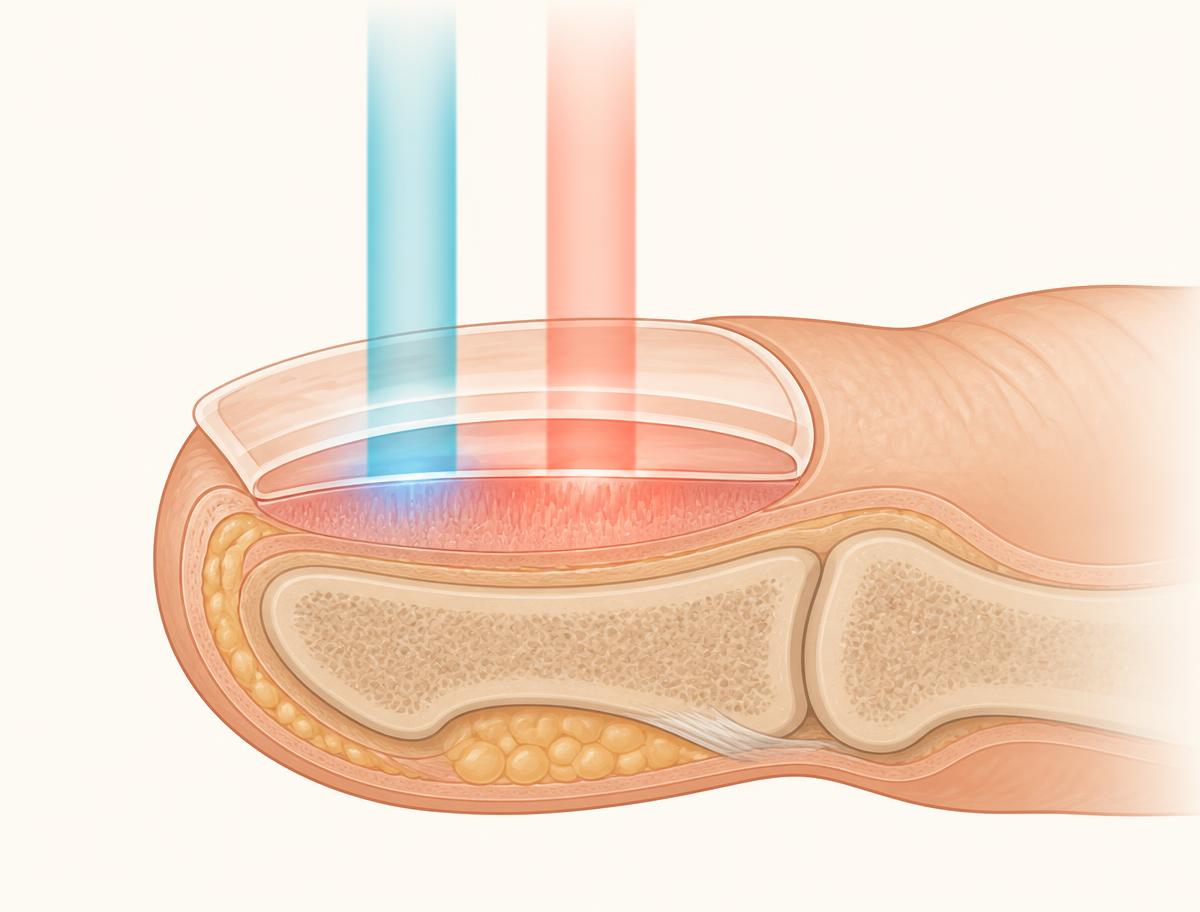
Nail fungus is not a stain sitting on top of the nail. It lives in the nail bed — the skin underneath the hard plate — and in the underside of the plate itself. That is why the nail thickens, yellows and crumbles from below rather than washing off, and why it keeps coming back after the surface has been scrubbed or filed.
It also explains the single most common disappointment in this category. A cream painted on the top of a nail has to cross a dense, largely impermeable keratin plate before it reaches anything alive. Most of it never does. Prescription lacquers are formulated to penetrate better and still take six to twelve months of daily use, with weekly filing, to give the medicine a shorter route.
Anything that is going to help has to solve that access problem: either travel through the body (oral tablets), be driven through the plate by energy (clinic lasers), or use a wavelength of light that passes through the plate into the tissue beneath. FungaBeam takes the last approach.
What FungaBeam emits, and why two wavelengths
FungaBeam surrounds the nail with 18 LEDs at a combined 36W, in two wavelengths chosen for two different jobs.
- 470nm blue light. The visible blue band, widely used in consumer devices against surface microbes. It works on and near the surface — the exposed plate, the folds at the sides of the nail, and the skin around it where re-infection often hides.
- 910nm near-infrared. A much longer wavelength, invisible to the eye and felt only as faint warmth. Longer wavelengths scatter less and travel further into tissue, so this is the half of the pairing that reaches under the plate into the nail bed.
The shell folds around the toe so the light arrives from several angles at once rather than from a single point above the nail. That matters on a thickened or ridged nail, where a flat beam from directly overhead leaves the sides in shadow.
There is no UV, no heat treatment, no drug, and nothing applied to the skin. A session feels like mild warmth and nothing else, and there is no downtime afterwards.
Using it: three steps, about 90 seconds
The whole point of an at-home device is that you will actually keep doing it. A session costs you less time than brushing your teeth.
- 1
Plug in the USB cable
FungaBeam runs from any USB port, wall plug or power bank. No prescription, no appointment, no clinic bill.
- 2
Pick your session length
Three timer modes on the top panel. Tap once, place your foot or hand inside the folding shell, and sit back.
- 3
Relax for 1.5 minutes a day
18 LEDs surround the nail with 470nm blue and 910nm red light. Stay consistent daily — that is what drives results.
Filmed by customers at home. Nothing sped up, nothing staged.
Start tonight instead of next month
Every week you wait is another week of nail that has to grow out later. FungaBeam is a one-off purchase with free tracked shipping and 30 days to send it back.
- From $34.99 per device
- Free tracked shipping
- 30-day money-back
“I have been using FungaBeam since January. My case has cleared up and my nails look great.” — Patricia L., Ohio, US
How light therapy compares with the other options
No option here is instant, and anything advertised as an overnight cure is selling you the idea rather than the result. Here is the honest picture, including where FungaBeam is the weaker choice.
| Option | Typical cost | Effort | The honest downside |
|---|---|---|---|
| At-home light therapy | One-off device purchase | About 90 seconds a day | Needs daily consistency for months; not a medical treatment |
| Topical creams | $10 – $30 per tube | Twice daily | Struggles to get through the nail plate to where the fungus lives |
| Prescription lacquers | $50 – $200 per course | Daily for 6 – 12 months | Long courses, modest clearance rates, weekly nail filing |
| Oral prescription (terbinafine) | $30 – $150 per course | One tablet daily, 6 – 12 weeks | Requires a doctor; liver monitoring and drug interactions |
| Clinic laser | $500 – $1,500 per course | 3 – 4 clinic visits | Rarely covered by insurance; repeat courses often needed |
Oral prescription antifungals remain the fastest route for a severe, painful or widespread infection, because they reach the nail bed through the bloodstream. If that is your situation, see a doctor — a device is not a substitute. Where at-home light therapy fits is the large middle ground: mild to moderate discolouration, people who cannot or would rather not take tablets, and people who do not want to spend clinic-laser money.
Is this right for your nails?
It tends to suit:
- Yellow, white or brown discolouration that starts at the tip or side of the nail.
- Mild to moderate thickening, where the nail is still recognisably a nail.
- One or several nails, fingers or toes, including nails you have already treated unsuccessfully with creams.
- People who want something drug-free that fits into an existing daily routine.
See a doctor or podiatrist first if:
- You have diabetes, poor circulation or a weakened immune system — foot infections are managed differently and need supervision.
- The nail is painful, the skin around it is red, swollen or leaking, or the infection is spreading.
- The nail lifted after an injury, or a dark streak runs lengthways through it — that is not fungus and needs looking at.
- The nail is severely deformed or detaching from the bed, where removal or oral treatment is usually the realistic route.
What to expect, week by week
Nails do not heal — they grow out. That single fact sets the timetable, no matter which treatment you choose. The damaged section at the front of the nail is dead keratin and will never recover; it has to grow forward and be trimmed away. Progress is a clear band widening from the base.
| Timeframe | What is happening | What you can see |
|---|---|---|
| Weeks 1 – 3 | Sessions become a habit; the damaged nail is unchanged | Usually nothing — this is the stage people quit at |
| Weeks 4 – 8 | New nail forming at the matrix grows out | A narrow clearer band at the base of the nail |
| Months 3 – 6 | Clear nail widens; damaged nail trimmed away gradually | Roughly half the plate can look healthier |
| Months 9 – 12 | A toenail fully replaces itself | The full nail grown out, if you kept going daily |
Toenails grow roughly 1mm a month and fingernails about twice that, so fingernails usually show change sooner. Results vary from person to person, and skipped days show up as a stalled band rather than a lost cause.
Getting the most out of every session
- Trim the nail short and lightly file the surface, so the light meets less thickness.
- Use it on clean, dry nails with no polish on — polish blocks light completely.
- Treat every affected nail, including the mild ones, or they reseed the ones you cleared.
- Pick a fixed moment in the day. Morning coffee or bedtime beats "when I remember".
- Change socks daily, rotate shoes, and let them dry fully between wears.
- Disinfect clippers and files between nails, and never share them.
- Photograph the nail monthly in the same light — month-to-month change is invisible day to day.
Real nails, real timeframes
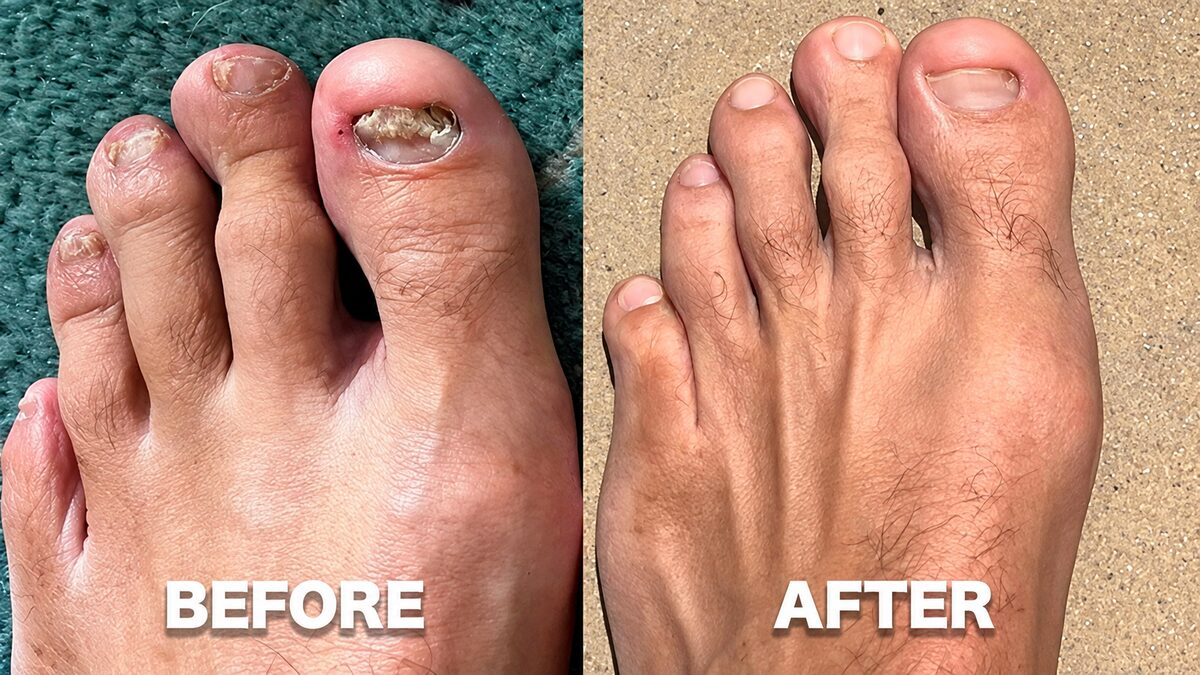
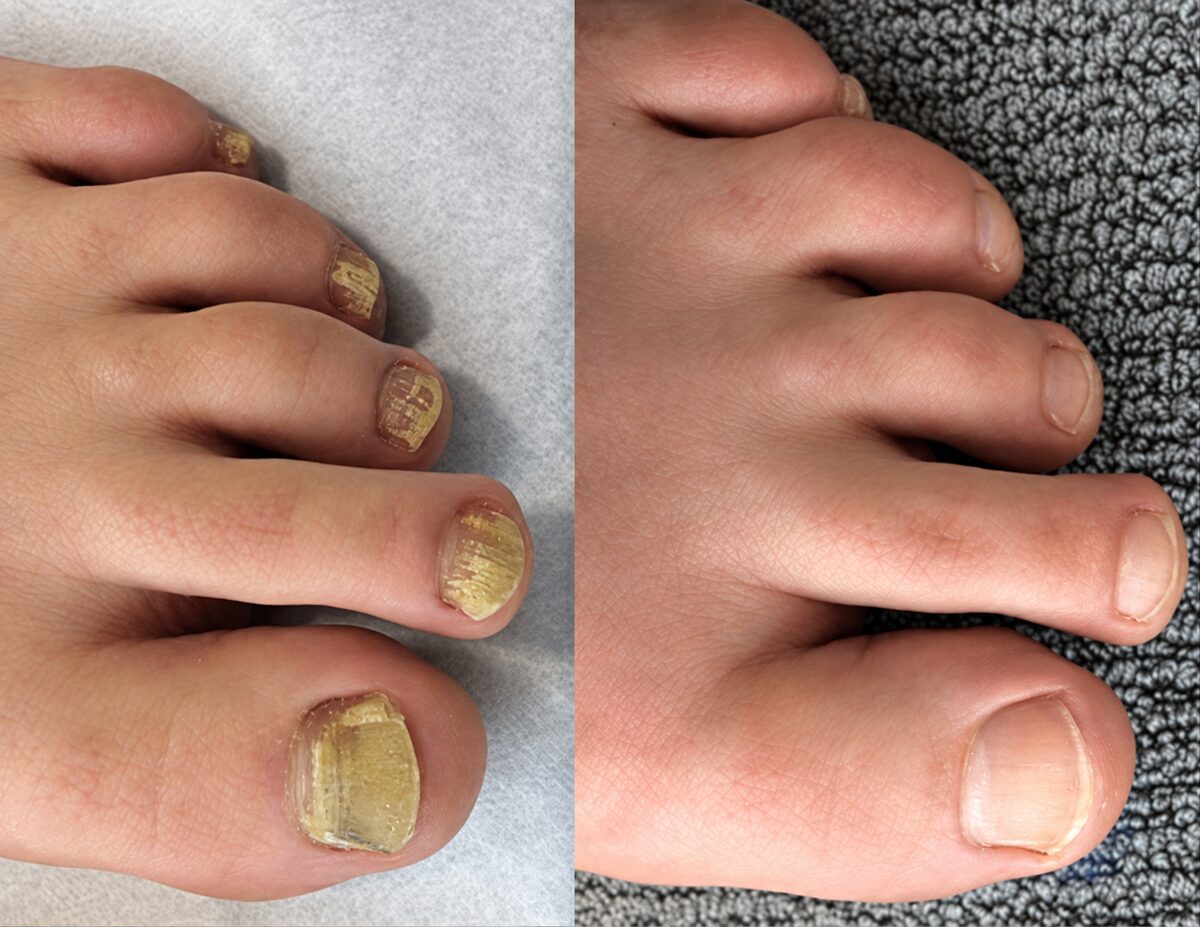
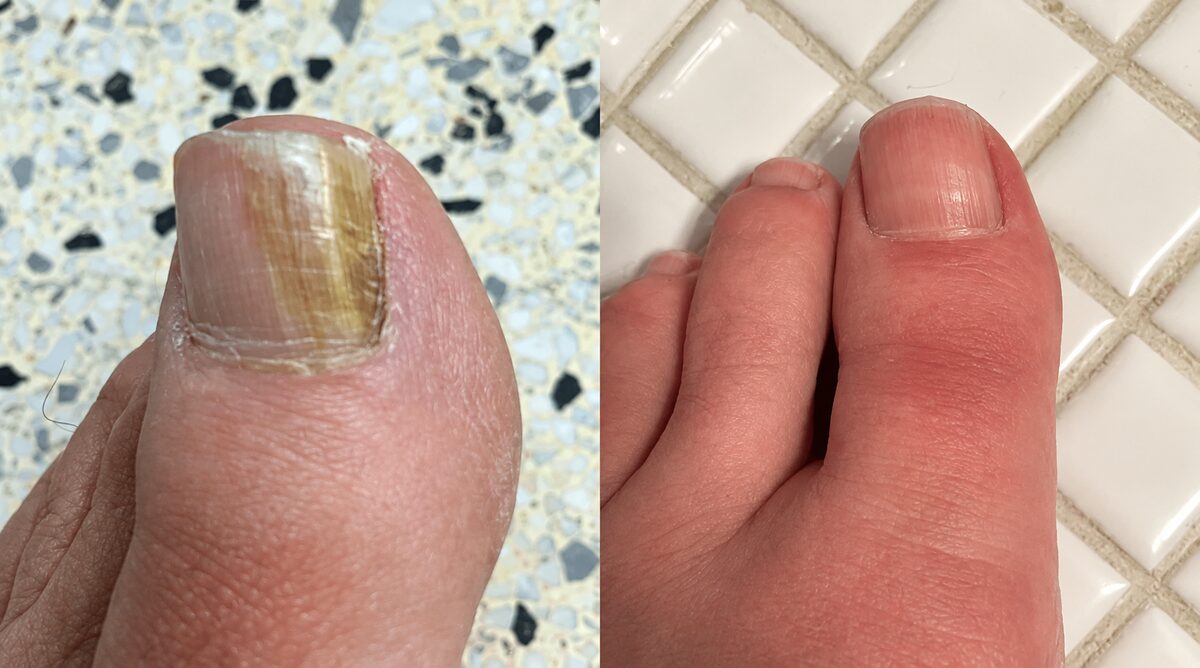
These are customer photos with the timeframe stated on each. They are not a promise of your own result, and the timeframes are months, not days.
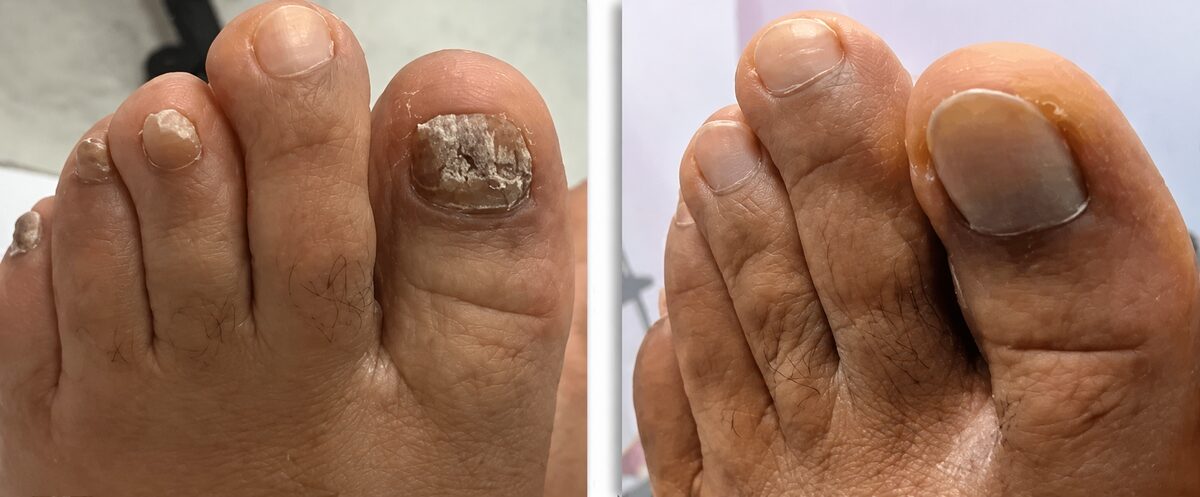
What FungaBeam is not
FungaBeam is a consumer wellness device. It is not a prescription medicine, it is not a clinic laser, and it does not diagnose, treat, cure or prevent disease. We do not claim a cure rate, and we would rather you bought it understanding that than be disappointed in month two.
What it does offer is a drug-free daily routine that targets the layer creams struggle to reach, for a one-off price rather than a course of clinic appointments — and 30 days to change your mind if it is not for you.
Frequently asked questions
Ready to start treating the nail bed tonight?
About 90 seconds a day, drug-free, one payment and no subscription. Free tracked shipping and a 30-day money-back guarantee.
- From $34.99 per device
- Free tracked shipping
- 30-day money-back
“I have been using FungaBeam since January. My case has cleared up and my nails look great.” — Patricia L., Ohio, US
Keep reading
- Nail fungus light therapy devices comparedWhat separates a real device from a cheap clip-on.
- Does laser work for toenail fungus?What clinic laser does, what it costs, and the evidence.
- What kills toenail fungus instantly?The honest answer, and what is genuinely fastest.
- Best nail fungus treatment by situationMatching the option to how bad the nail actually is.
Sources
This page is general information, not medical advice. FungaBeam is a consumer wellness device and is not intended to diagnose, treat, cure or prevent any disease. Speak to a doctor or podiatrist about your own situation, particularly if you have diabetes, circulation problems or worsening symptoms.