Published · Updated
The quick answer
- Does Vicks VapoRub work on toenail fungus? Sometimes, partially, and slowly — one small pilot study found some improvement after nearly a year of daily use, not a cure in most participants.
- Its camphor, menthol and eucalyptus oil do show antifungal activity in a laboratory dish, but a dish is not a nail plate.
- It is worth trying only if you accept a three-month minimum trial, weekly filing, and the possibility that it simply will not reach a well-established infection.
- If it has not produced visible new growth at the base of the nail by twelve weeks, it is a signal to change approach rather than push through.
What it is and why people try it
Vicks VapoRub was formulated as a chest rub, not a nail treatment, but its ingredient list — camphor, menthol, eucalyptus oil and a petrolatum base — happens to include compounds with documented antifungal activity against dermatophytes in laboratory testing. That single fact, combined with the product already sitting in most bathroom cabinets, is why it has become the default first thing people try before ever seeing a doctor.
The appeal is obvious: it costs a few dollars, it is available everywhere, and it feels like a low-risk experiment compared with a prescription tablet or a clinic visit. For a mild, early, cosmetic-only case, that low-risk framing is reasonable. For a thick, crumbling, years-old infection, it is often where people lose months they did not need to lose.
What the evidence actually shows
The most-cited piece of research is a small, uncontrolled pilot study in which a group of participants applied Vicks VapoRub daily to affected toenails for up to forty-eight weeks. A minority achieved what researchers classed as a mycological or clinical cure; a larger group showed partial improvement in appearance, and some showed no change at all.
That is a genuinely different result from the way the study is usually summarised online, which tends to shorten it to 'Vicks cures toenail fungus.' It was not placebo-controlled, it was not blinded, and it measured a modest effect over the better part of a year of unbroken daily use — not a quick fix.
Laboratory antifungal activity and clinical cure of onychomycosis are two different claims. Camphor and eucalyptol can measurably slow fungal growth in a petri dish; whether enough of that activity reaches the fungus living under a thickened nail plate is the actual question, and it is the one the evidence answers least convincingly.
How people use it
The routine reported in the pilot study, and the one most commonly repeated online, looks like this.
- Wash and thoroughly dry the affected foot.
- Clip the nail short and file the thickened top surface down as far as comfortably possible.
- Rub a small amount of Vicks into the nail surface and the skin at its edges once or twice a day.
- Cover with a clean, breathable sock overnight to avoid staining bedding.
- Repeat daily, without gaps, for a minimum of twelve weeks before judging results.
How long it takes and what working looks like
Because the underlying pilot study ran for up to forty-eight weeks, anyone starting Vicks should mentally budget for months, not weeks. The earliest realistic sign of progress is a thin band of clear, normal-coloured nail appearing at the cuticle — the newest nail growing out from underneath the infection — usually not before eight to twelve weeks even in a favourable case.
Take a photograph on day one against a consistent background and repeat it every few weeks. If the new growth at the base is still discoloured after three months, the treatment is not reaching the infection in your case, however diligently you have applied it.
Risks and what not to do
On intact skin around a toenail, Vicks is generally low-risk. It should not be used on broken skin, open sores, or in children under two, and the manufacturer specifically warns against it. Stop immediately if the surrounding skin becomes red, itchy or starts to peel — that is contact irritation, not a sign the product is 'working.'
Anyone with diabetes, poor circulation, or reduced sensation in the feet should have any foot infection assessed by a clinician before relying on any self-treatment, because minor skin breaks in that group can escalate quickly.
If three months of Vicks did nothing
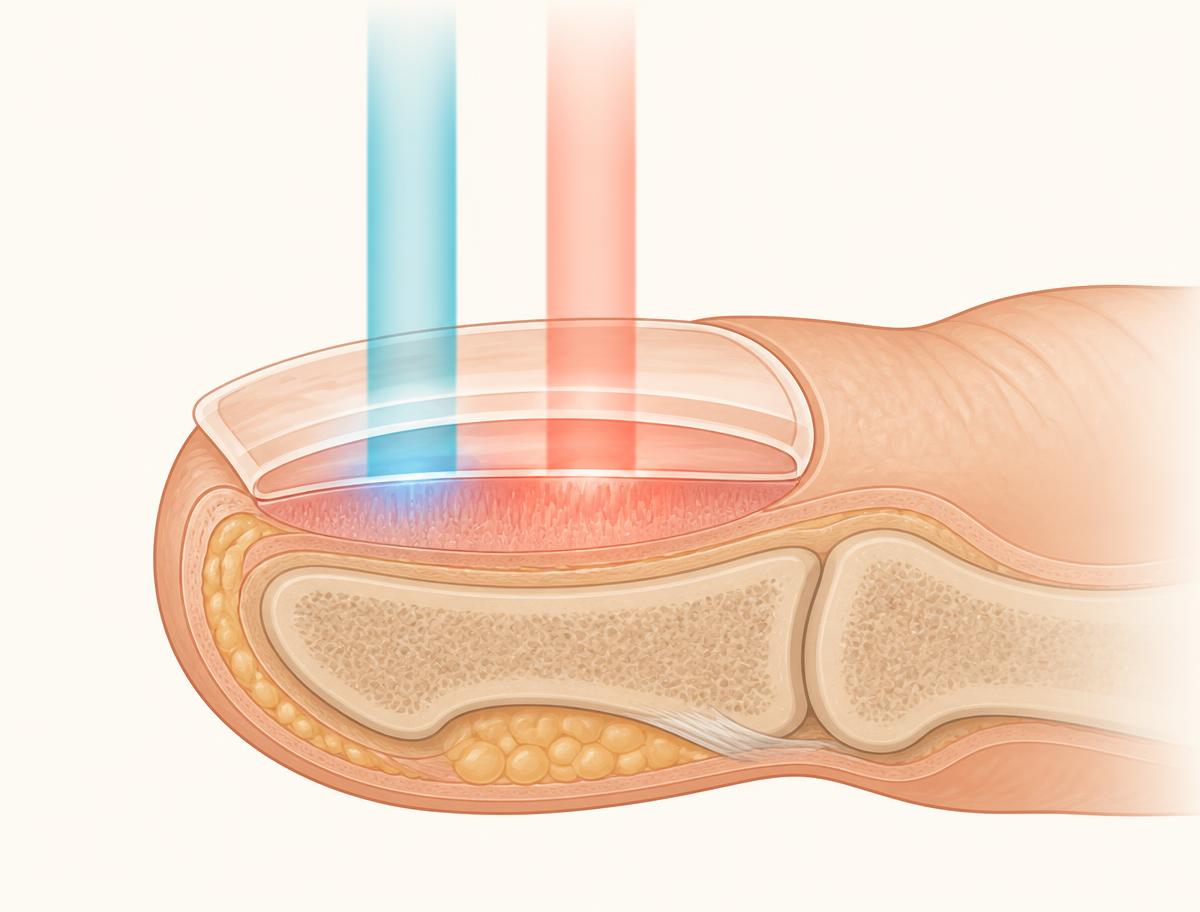
A light-based device reaches the nail bed rather than sitting on top of the plate. One-off cost, 30-day money-back guarantee.
- From $34.99 per device
- Free tracked shipping
- 30-day money-back
“I have been using FungaBeam since January. My case has cleared up and my nails look great.” — Patricia L., Ohio, US
Why the nail plate defeats most topicals
The core limitation is not the ingredients, it is delivery. A healthy toenail plate is several layers of tightly packed keratin, evolved specifically to be a barrier. An ointment sitting on top of it reaches the infection living underneath — in the nail bed and the deeper layers of the plate — in only trace amounts, no matter how antifungal the ingredient is in a dish.
This is why filing the nail thin before each application is not an optional extra; people who report the best results with Vicks are almost always the ones who file aggressively and consistently, because that is the step that actually shortens the distance the product has to travel.
It also explains the pattern in the evidence: mild, early, surface-level infections respond far more often than thick nails that have been fungal for several years, simply because there is less keratin in the way.
Vicks compared with other approaches
A rough sense of where Vicks sits against the alternatives people typically consider next.
| Approach | Evidence strength | Typical cost | Realistic timeline | Penetrates the nail plate? |
|---|---|---|---|---|
| Vicks VapoRub | Weak — one small pilot study | Under $10 | 3–12 months, inconsistent | Poorly |
| Diluted tea tree oil | Weak-moderate, small trials | $10–20 | 3+ months, inconsistent | Poorly |
| Oral terbinafine (prescription) | Strong, multiple trials | Prescription cost varies | 3 months course, 9–12 months to see full nail | Yes, via bloodstream |
| Daily light therapy (e.g. FungaBeam) | Emerging, device-based | From $34.99 | 4–8 weeks to first new growth, 9–12 months full nail | Yes, light passes through the plate |
What to combine it with
Whatever topical you choose, the supporting habits matter as much as the product. Keep nails clipped short and filed thin every week, not just at the start. Wash and thoroughly dry feet daily, paying particular attention between the toes. Change socks daily and choose breathable, moisture-wicking materials over synthetic ones that trap sweat.
Treat shoes, not just feet: rotate at least two pairs so each has a full day to dry out, and consider an antifungal shoe spray or UV shoe sanitiser, since reinfection from footwear is one of the most common reasons a treatment that was working appears to stop.
When to stop and try something else
Give it a genuinely fair trial: daily, correct application with weekly filing for a full twelve weeks, judged only by the band of new nail at the base. If that section is coming in just as discoloured as the rest after three months, continuing for the sake of it rarely changes the outcome — the barrier problem does not resolve with more time using the same method.
See a doctor or podiatrist if the nail is painful, if the skin around it becomes infected, if you have diabetes, or if you simply want a diagnosis confirmed before spending more months guessing — not every thickened, discoloured nail is fungal.
Frequently asked questions
Ready to start treating the nail bed tonight?
If Vicks has not changed the nail at the base after twelve weeks, it is time to try something that actually reaches the nail bed.
- From $34.99 per device
- Free tracked shipping
- 30-day money-back
“I have been using FungaBeam since January. My case has cleared up and my nails look great.” — Patricia L., Ohio, US
Keep reading
- Tea tree oilCorrect dilution, application method, and what the trials actually found.
- Hydrogen peroxideSoaks, dilution, skin risk, and why disinfecting the surface rarely fixes the bed.
- What kills it instantly?The honest answer to the internet's most searched nail fungus question.
- Best treatment comparedEvery option ranked by evidence, cost, effort and speed.
Sources
This page is general information, not medical advice. FungaBeam is a consumer wellness device and is not intended to diagnose, treat, cure or prevent any disease. Speak to a doctor or podiatrist about your own situation, particularly if you have diabetes, circulation problems or worsening symptoms.