Published · Updated
The quick answer
- Look for stated wavelengths (such as 470nm blue and 910nm near-infrared) — vague terms like 'photon therapy' with no numbers are a red flag.
- Session length matters: anything over 5 minutes daily is unlikely to be sustained for the months treatment actually takes.
- Cheap unbranded devices often lack a real return window or warranty; 30 days and 12 months respectively are reasonable minimums.
- FungaBeam specifies 470nm and 910nm LEDs, 36W across 18 LEDs, roughly 90-second sessions, a 30-day guarantee and a 12-month warranty.
What these devices actually claim to do
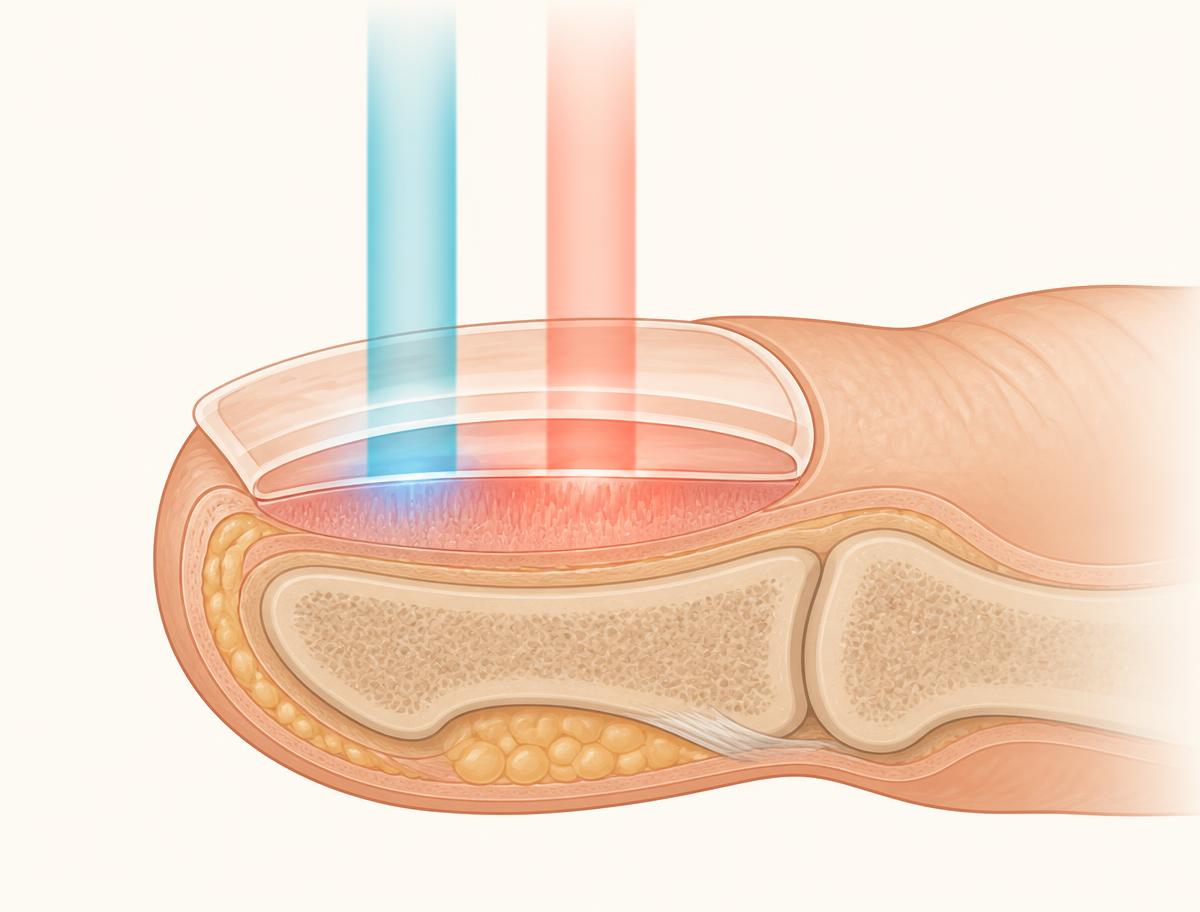
At-home light therapy devices for nail fungus use LEDs to shine specific wavelengths of light through the nail plate toward the nail bed underneath, where the infection actually lives. They are drug-free and are not intended to diagnose, treat, cure or prevent disease — they are consumer wellness devices, not medical devices, and any product implying otherwise should be treated with suspicion.
The category has grown quickly, and quality varies enormously. Some devices are built with clearly stated specifications and testing behind them; others are generic LED gadgets rebranded with fungus-specific marketing and no real detail on what is inside.
Wavelengths explained in plain terms
Blue light, typically stated around 400–470nm, and near-infrared light, typically stated around 850–910nm, are the two ranges most commonly used in this category. Blue light sits at the shorter end of the visible spectrum; near-infrared sits just beyond what the eye can see and is associated with somewhat deeper tissue penetration than visible light.
The specific numbers matter less than whether a number is given at all. A listing that says only 'advanced photon technology' or 'professional-grade light therapy' without naming a wavelength in nanometres is telling you nothing verifiable. A device that states 470nm and 910nm, as FungaBeam does, gives you something concrete to compare against other products or simply look up.
Power, LED count and session length
Total power draw (measured in watts) and LED count give a rough sense of how much light output a device is actually producing, though neither number alone tells the whole story without knowing the wavelength and how the light is focused. FungaBeam states 36W across 18 LEDs as a reference point for comparison.
Session length is arguably more practically important than any spec sheet number, because a device you will not use daily for months delivers nothing, however well-specified it is. Sessions in the 60–180 second range are realistic to sustain; devices demanding 15–20 minutes daily are far more likely to be abandoned within the first few weeks.
Build quality and coverage
Check whether a device is designed for the toe alone, or whether it opens wide enough to also fit fingers — a dual-purpose design is better value if more than one nail type is affected in your household. A folding or hinged shell that fully surrounds the nail tends to deliver more even coverage than an open panel you have to hold in position yourself.
USB power is a practical plus: it means the device runs from a wall adapter, laptop or power bank rather than needing disposable batteries, which matters over months of daily use.
Red flags in cheap devices
- No stated wavelength in nanometres, only vague marketing language.
- No stated power output or LED count anywhere on the listing.
- Return window under 14 days — too short to judge a treatment that needs weeks to show anything.
- No warranty mentioned, or a warranty shorter than a few months.
- Reviews that only ever mention the packaging or unboxing, never the nail itself, months later.
- Marketing that promises visible results within days — nails cannot change that fast, regardless of the device.
A device that states its specs
470nm and 910nm LEDs, 36W, 18 LEDs, from $34.99 with free shipping and a 30-day money-back guarantee.
- From $34.99 per device
- Free tracked shipping
- 30-day money-back
“I have been using FungaBeam since January. My case has cleared up and my nails look great.” — Patricia L., Ohio, US
Comparing device specs at a glance
Use this table on any device you are considering, not just FungaBeam — it is a reasonable framework for the whole category, and most of the genuinely poor products in this space fail on at least two or three of these rows.
| Spec | Weak device | Reasonable device | FungaBeam |
|---|---|---|---|
| Wavelength stated? | No / vague | Yes, one wavelength | Yes — 470nm and 910nm |
| Session length | 10–20 minutes | 2–5 minutes | ~90 seconds |
| Coverage | Toes only | Toes and fingers | Toes and fingers, folding shell |
| Return window | None or under 14 days | 14–30 days | 30 days |
| Warranty | None stated | 6–12 months | 12 months (2 years with add-on) |
Cost and pack sizing
Devices in this category generally range from under $30 to well over $100 for a single unit; price alone does not indicate quality, and some of the least specified products are priced in the middle of that range purely on marketing. Comparing against the specification checklist above is a better filter than price.
| Pack | Price per device | Best for |
|---|---|---|
| 1 device | $49.99 | Trying it on one nail |
| 2 devices | $44.99 each | You and a partner |
| 3 devices | $39.99 each | Most popular — households treating several nails |
| 4 devices | $34.99 each | Lowest per-unit price |
How FungaBeam fits this checklist
FungaBeam states 470nm blue and 910nm near-infrared wavelengths, 36W across 18 LEDs, roughly 90-second sessions using one of three timer modes, a folding shell sized for hands and feet, free tracked shipping to the US, Canada, UK, Ireland, Australia and New Zealand, a 30-day money-back guarantee, and a 12-month warranty extendable to two years with the optional Coverage add-on.
It suits people who want a device-based, drug-free daily routine and are comfortable with the several-month timeline every device in this category realistically requires. It is not a fit for anyone expecting a faster result than nail growth physically allows, and it is not a substitute for medical assessment of a severe or unusual-looking nail.
What people get wrong when buying a device
The most common mistake is buying based on the review count or star rating alone without checking whether the listing states any real specification. The second is buying a device with a long session time, using it inconsistently because it does not fit into a daily routine, and blaming the device rather than the mismatch between the product and the buyer's actual habits.
Frequently asked questions
Ready to start treating the nail bed tonight?
Whichever device you choose, check the wavelengths are stated, the session is short enough to actually do daily, and the return window is long enough to judge it fairly.
- From $34.99 per device
- Free tracked shipping
- 30-day money-back
“I have been using FungaBeam since January. My case has cleared up and my nails look great.” — Patricia L., Ohio, US
Keep reading
- FungaBeam reviewWhat the device is, how it is used, and an honest account of who it suits.
- Does laser work?What the evidence supports, and how clinic lasers differ from at-home light devices.
- Antifungal cream guideWhy creams struggle with nails, and how to give one a real chance.
- Best treatment by situationMild, moderate, severe or recurring — matched to the right treatment for each.
Sources
This page is general information, not medical advice. FungaBeam is a consumer wellness device and is not intended to diagnose, treat, cure or prevent any disease. Speak to a doctor or podiatrist about your own situation, particularly if you have diabetes, circulation problems or worsening symptoms.