Published · Updated
The quick answer
- The Listerine and vinegar soak is plausible on paper — both ingredients have some antimicrobial or pH-lowering effect — but there are no controlled human trials showing it clears onychomycosis.
- Its most reliable benefit is softening thick nails so they are easier and safer to file, which helps whatever treatment you pair it with.
- The commitment (twenty to thirty minutes soaking, most days, for months) is where most people give up before any real judgement can be made.
- Treat it as preparation for a real treatment, not a treatment on its own.
What it is and why people try it
The recipe — equal parts amber Listerine mouthwash and white vinegar in a basin of water — has circulated online for years, popular enough that it now appears as a standard suggestion on home-remedy lists alongside Vicks and tea tree oil. Its popularity owes a lot to how it sounds: two household products, both smelling strongly antiseptic, combined into something that feels like a proper treatment.
People try it because it is inexpensive, does not require diluting an essential oil correctly, and the soaking ritual itself feels thorough compared with a quick dab of cream.
What the evidence actually shows
Listerine contains thymol, eucalyptol, menthol and methyl salicylate — essential-oil derivatives with documented antimicrobial activity in laboratory settings, largely studied in the context of oral bacteria rather than nail fungus specifically. Vinegar lowers the pH of the soak, and dermatophytes generally prefer a more neutral environment, so there is a plausible mechanism.
What does not exist is any controlled human trial demonstrating that this combination clears onychomycosis. The claim rests entirely on the individual ingredients' laboratory properties and a large volume of anecdotal reporting, not on nail-specific research. As with every topical here, the same delivery problem applies: a twenty-minute soak does not saturate a dense keratin nail plate regardless of what is dissolved in the water.
How people use it
- Equal parts amber Listerine and white vinegar in a basin, enough to cover the toes.
- Soak the affected foot for twenty to thirty minutes.
- Scrub the nail gently with a soft brush, then dry the foot completely.
- File thickened nail down once a week.
- Repeat daily or every other day for at least three months.
Timeline and what working looks like
Because there is no trial data specific to this combination, there is no evidence-based timeline to point to. Anecdotal reports that describe success generally involve months of near-daily soaking, and the change they describe is most often softer, less thickened nails rather than a documented clearance of the fungus.
If you try it, judge it the same way as any other topical: photograph the nail regularly and look specifically for clear new growth at the base, not just a softer or less crumbly texture, which can happen from the soaking alone without the infection actually clearing.
Risks and what to watch for
The main risk is not the ingredients individually but the routine: thirty minutes of daily wet feet, if not followed by meticulous drying, creates a damp environment that favours the very organisms you are trying to eliminate. Some people also find the vinegar irritating to any small skin cracks around the nail, particularly with daily use over months.
Anyone with diabetes, neuropathy or reduced circulation should have a clinician review any new foot soak routine before starting, since prolonged soaking can affect skin integrity in ways that matter more for that group.
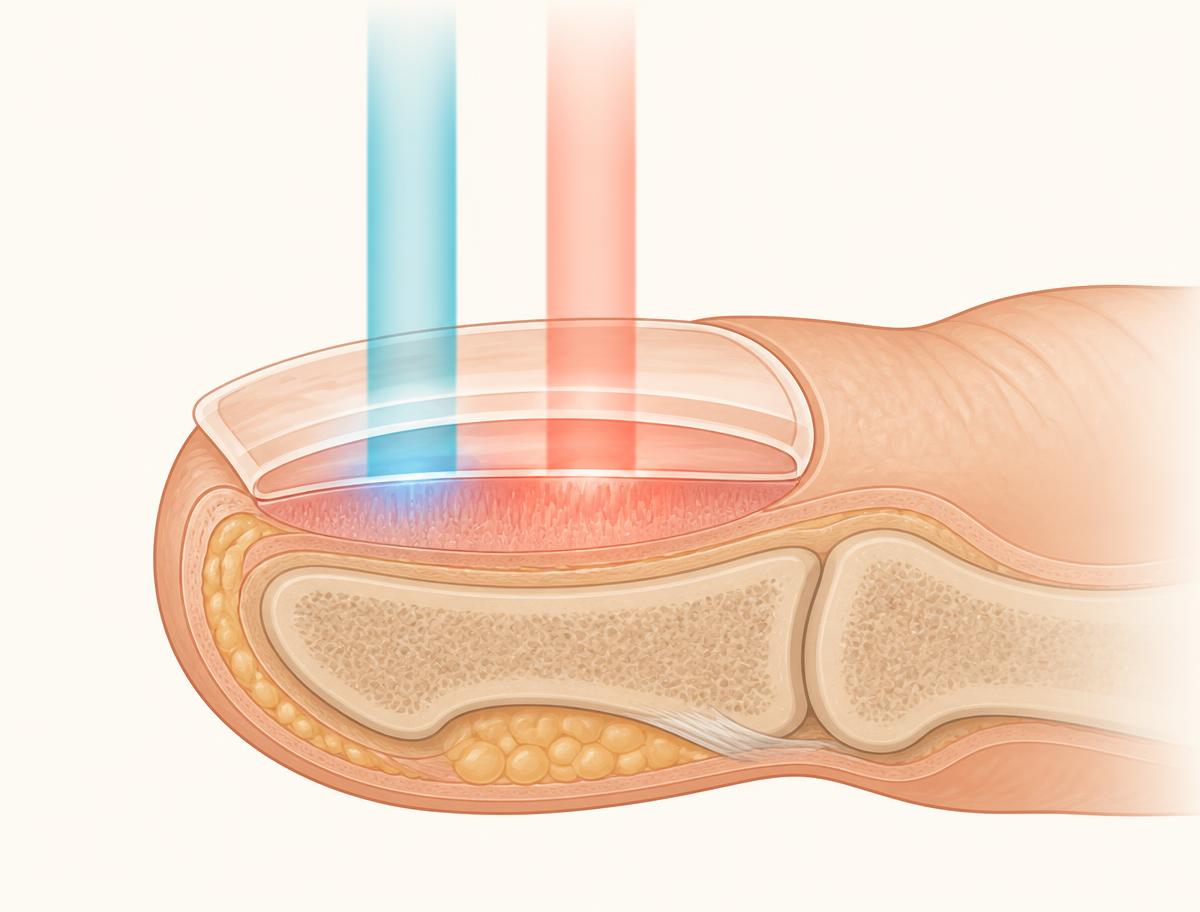
Something that reaches the infection
Daily 90-second light sessions instead of nightly half-hour soaks.
- From $34.99 per device
- Free tracked shipping
- 30-day money-back
“I have been using FungaBeam since January. My case has cleared up and my nails look great.” — Patricia L., Ohio, US
Why the nail plate defeats most topicals
As with Vicks, tea tree oil and hydrogen peroxide, the limiting factor is not whether the ingredients have some antimicrobial property — several of them clearly do in a laboratory setting — but whether enough of that activity reaches the fungus living under a dense, multi-layered keratin nail plate. A soak wets and softens the outer surface; it does not saturate the deeper layers where an established infection lives.
This is precisely why the one part of this routine with genuine, direct value is the filing step: physically thinning the nail is one of the few actions that reliably shortens the distance any product has to travel.
Listerine soak compared with other approaches
Where it fits relative to better-evidenced options.
| Approach | Evidence strength | Time commitment | Typical cost | Main real benefit |
|---|---|---|---|---|
| Listerine and vinegar soak | Anecdotal only, no nail-specific trials | 20–30 min daily | $10–15 | Softens nail for easier filing |
| Diluted tea tree oil | Moderate — small trials | A few minutes twice daily | $10–20 | Some direct antifungal exposure |
| Oral terbinafine (prescription) | Strong, multiple trials | One tablet daily, no soaking | Prescription cost varies | Systemic delivery to the nail bed |
| Daily light therapy (e.g. FungaBeam) | Emerging, device-based | 90 seconds daily | From $34.99 | Reaches the nail bed without soaking |
What to combine it with
If you use the soak, treat it purely as a softening step before filing, then follow with a product actually intended to reach the infection — whether that is a diluted essential oil, a prescription topical, or a light-based device — applied to the freshly thinned nail. Always dry the foot completely afterwards, including between the toes.
Keep socks and shoes in the routine too: fresh socks daily, shoes rotated to dry fully between wears, and periodic disinfection of shoes and shower surfaces to reduce the chance of reinfecting a nail that is otherwise improving.
When to stop and when to see a doctor
Many people quit the nightly soak after a few weeks simply because of the time commitment, and inconsistency — more than any ingredient choice — is why home remedies fail to show results. If you have kept it up correctly for three months with no new clear growth at the base of the nail, that is a fair point to redirect the daily habit toward a treatment with a shorter, more reliable routine.
See a doctor if the nail is painful, if the skin becomes broken or infected-looking, if you have diabetes or circulation problems, or if you want a confirmed diagnosis before committing more months to any single method.
Frequently asked questions
Ready to start treating the nail bed tonight?
Use the soak to soften and file the nail, then put the daily effort into a treatment that can reach what's underneath.
- From $34.99 per device
- Free tracked shipping
- 30-day money-back
“I have been using FungaBeam since January. My case has cleared up and my nails look great.” — Patricia L., Ohio, US
Keep reading
- Hydrogen peroxideSoaks, dilution, skin risk, and why disinfecting the surface rarely fixes the bed.
- Tea tree oilCorrect dilution, application method, and what the trials actually found.
- Vicks VapoRubThe evidence, the method people use, and why results are so inconsistent.
- Best treatment comparedEvery option ranked by evidence, cost, effort and speed.
Sources
This page is general information, not medical advice. FungaBeam is a consumer wellness device and is not intended to diagnose, treat, cure or prevent any disease. Speak to a doctor or podiatrist about your own situation, particularly if you have diabetes, circulation problems or worsening symptoms.