Published · Updated
The quick answer
- A toenail takes nine to twelve months to fully grow out and replace itself, so that is the realistic timeline for a toenail fungus infection to fully clear, regardless of treatment.
- Fingernails grow faster and typically clear in four to six months.
- The first meaningful sign of progress — a clear band of new nail at the cuticle — usually shows up at four to eight weeks if the treatment is working.
- The single biggest factor that lengthens the timeline is inconsistency, not the treatment itself.
The honest timeline
Assuming a consistent daily routine from day one, most people follow a broadly similar arc regardless of which treatment they choose, because the limiting factor is nail growth, not the treatment's speed.
- Weeks 1–3: no visible change whatsoever. This is expected, and it is when most people wrongly conclude treatment 'isn't working' and give up.
- Weeks 4–8: a clearer, smoother band of new nail becomes visible at the base, closest to the cuticle.
- Months 3–6: that clear band widens noticeably as you trim the damaged tip away during regular nail maintenance.
- Months 9–12: a toenail has completely replaced itself. Fingernails reach this point faster, in four to six months.
Why growth rate sets the limit, not treatment strength
A toenail grows roughly one to two millimetres a month, and a big toenail is about twelve to fifteen millimetres long from cuticle to tip. Do the arithmetic and you get most of a year, before accounting for the fact that nail growth slows with age, poor circulation, and some medical conditions.
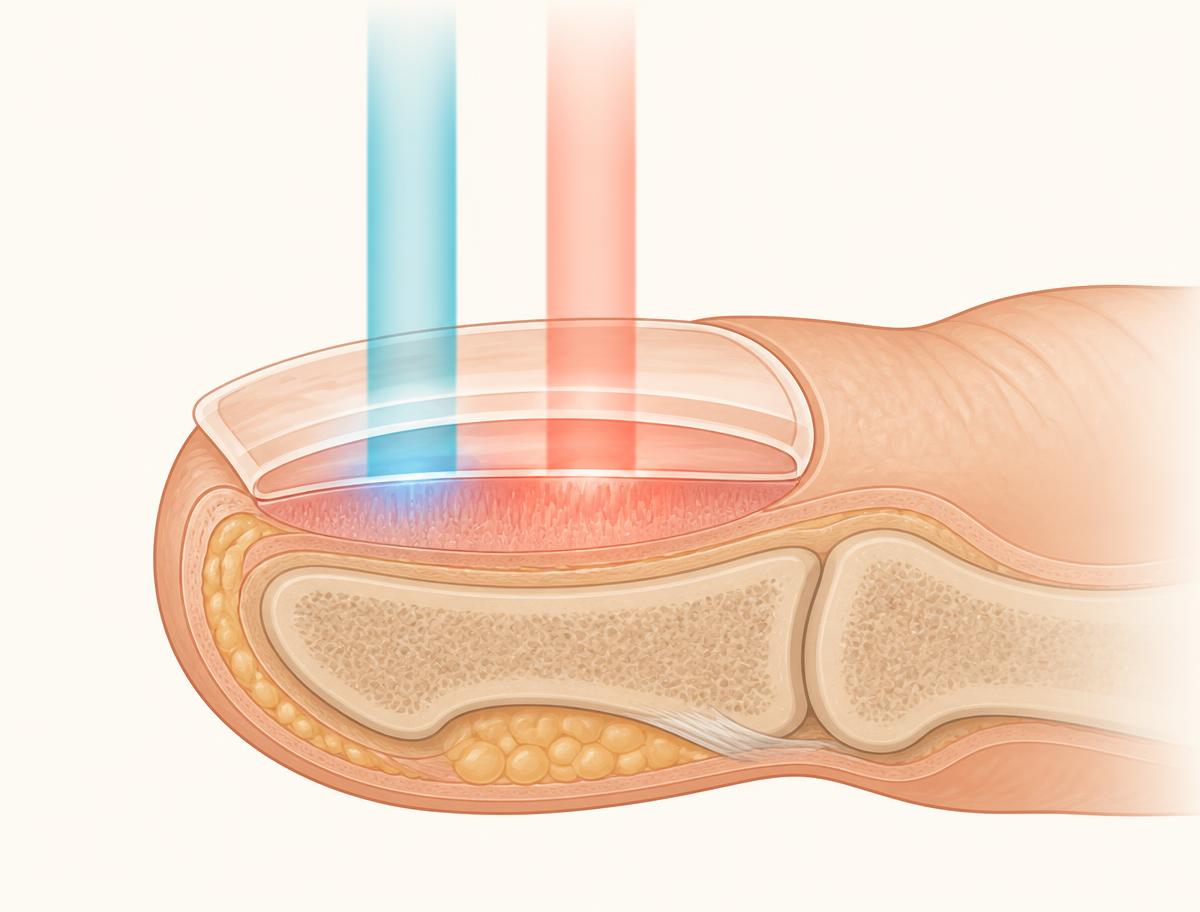
No treatment shortens this underlying arithmetic. Prescription tablets, clinic laser and at-home light devices all work on the same constraint: they stop new nail from being infected as it forms, which is different from making the nail grow faster. This is why 'how fast does it work' and 'how long until it's cured' have different answers — the first is about stopping the fungus, the second is about the nail catching up.
Timeline by treatment type
| Treatment | First visible new growth | Typical full clearance |
|---|---|---|
| Oral antifungal (prescription) | 6–10 weeks | 9–12 months |
| Topical prescription lacquer | 3–6 months | 10–12 months, mild cases only |
| In-clinic laser | 8–12 weeks | 9–12 months |
| At-home light therapy | 4–8 weeks | 9–12 months |
| Fingernail infection (any treatment) | 3–5 weeks | 4–6 months |
How to tell if it is working at week eight
Put your day-one photograph next to the nail today and look only at the two or three millimetres nearest the cuticle. Clear, smooth, normal-coloured new growth means the treatment is working even if ninety percent of the nail still looks awful — that older section is simply waiting to be trimmed away as it grows out.
Discoloured new growth after two full months of consistent treatment means it is not working, and that is the point to escalate to a different or stronger treatment rather than waiting longer on the same routine.
Start the clock today
Every week you delay is a week added to the end of the timeline.
- From $34.99 per device
- Free tracked shipping
- 30-day money-back
“I have been using FungaBeam since January. My case has cleared up and my nails look great.” — Patricia L., Ohio, US
What makes it take longer
- Missing sessions or applications — by far the biggest factor in extended timelines
- Untreated athlete's foot reinfecting the nail from the surrounding skin
- A thick nail that has never been filed down, blocking treatment from reaching the bed
- Damp shoes worn every day without rotation
- Age and reduced circulation, which slow nail growth generally
- Switching treatments frequently instead of giving one a fair trial
What can realistically shorten it
Nothing shortens the underlying nail growth rate, but several habits shorten how long visible symptoms persist: filing the nail down regularly so treatment reaches the infected tissue, treating the surrounding skin at the same time, trimming the damaged tip away as new growth appears rather than letting it snag and split, and being genuinely consistent with whichever treatment you chose.
Setting expectations that will not disappoint you
The most common reason people feel a treatment 'failed' is that they expected a visibly normal nail within a few weeks. Treat the four-to-eight-week mark as the checkpoint for 'is this working at all,' and the nine-to-twelve-month mark as the checkpoint for 'is this finished' — not before.
Frequently asked questions
Ready to start treating the nail bed tonight?
The sooner you start a consistent daily routine, the sooner the twelve-month clock finishes.
- From $34.99 per device
- Free tracked shipping
- 30-day money-back
“I have been using FungaBeam since January. My case has cleared up and my nails look great.” — Patricia L., Ohio, US
Keep reading
- What kills it instantly?The honest answer to the internet's most searched nail fungus question.
- Step-by-step planA month-by-month routine covering the nail, the skin, the shoes and the tracking.
- Thick yellow toenailsFungus, trauma, age or polish? Identify the cause and pick the right fix.
- FungaBeam reviewWhat the device is, how it is used, and an honest account of who it suits.
Sources
This page is general information, not medical advice. FungaBeam is a consumer wellness device and is not intended to diagnose, treat, cure or prevent any disease. Speak to a doctor or podiatrist about your own situation, particularly if you have diabetes, circulation problems or worsening symptoms.