Published · Updated
The quick answer
- A black toenail is most often a bruise (subungual haematoma) or an advanced fungal infection, not something dangerous.
- A bruise appears suddenly, often after impact, and moves toward the tip as a defined patch as the nail grows.
- Advanced fungal nails darken gradually and are also thickened and crumbly, unlike a clean bruise.
- A dark lengthways band with no injury history, especially if it widens or spreads onto the skin, needs prompt medical assessment.
Bruising under the nail
A subungual haematoma is blood trapped beneath the plate, usually from a dropped object or from repeated impact in running shoes that are half a size too small. It often appears suddenly, can be tender for a few days, and moves toward the tip as a defined patch as the nail grows outward over the following weeks.
It needs no specific treatment beyond better-fitting shoes and time, though a large, very painful haematoma covering most of the nail bed should be seen the same day, since pressure sometimes needs to be released to relieve pain.
Advanced fungal infection
Long-standing fungal nails can darken to brown or black as debris and pigment-producing organisms build up under the plate. The giveaway is context: the nail is also thickened and crumbly, the border of the discolouration is irregular rather than a clean defined patch, and it arrived gradually over months rather than overnight.
This pattern is common in nails that have been infected for a year or more without treatment, particularly in people who did not notice the earlier yellow or brown stage.
Other causes worth knowing
Certain medications, some skin conditions, and rarely a benign or malignant growth in the nail matrix can also cause dark discolouration. These are far less common than bruising or fungus but are the reason black nails deserve more caution than yellow ones.
How it is diagnosed
A clinician can usually distinguish a bruise from fungus by history and appearance alone, sometimes confirmed with dermoscopy. If a longitudinal dark band is present with no clear injury, a biopsy of the nail matrix may be recommended to rule out a pigmented lesion, which is a precaution rather than a sign that something serious is likely.
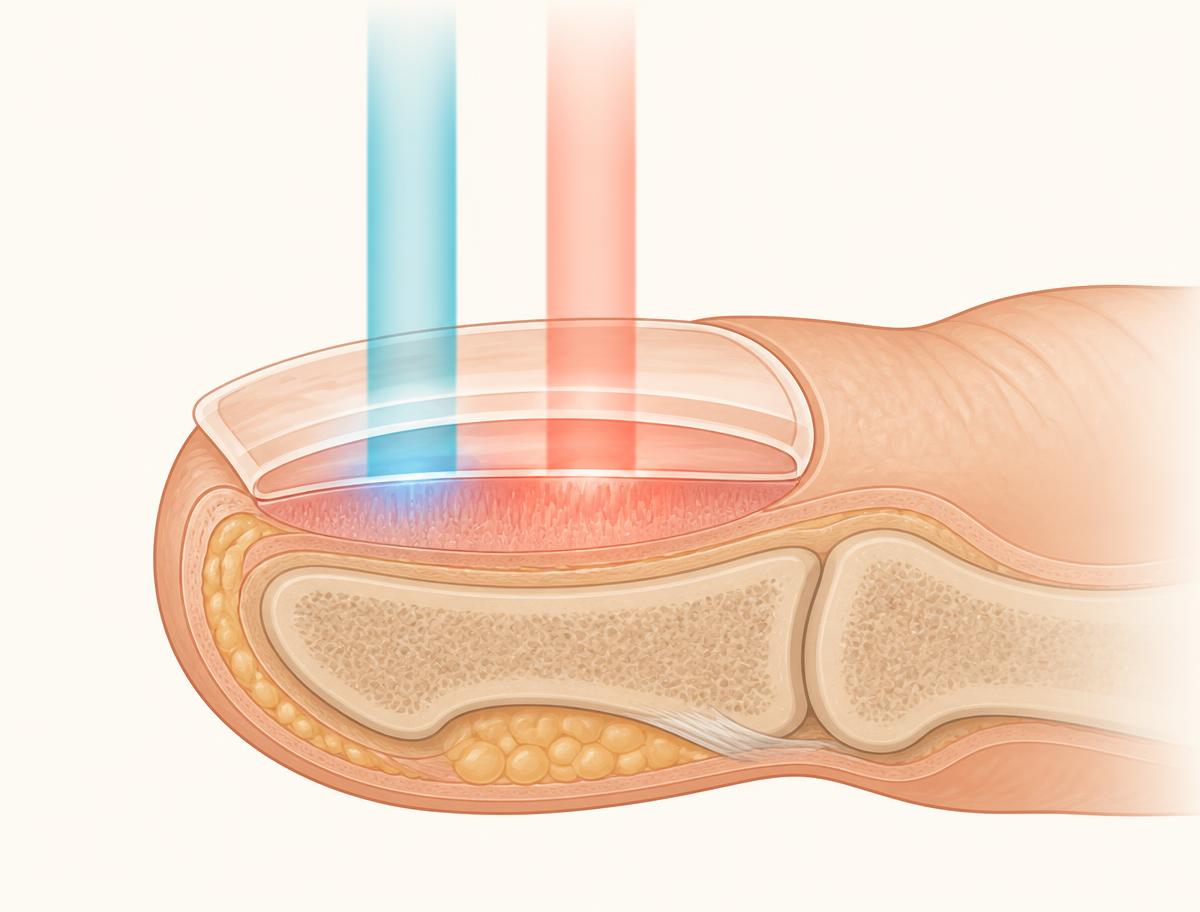
Once it is confirmed as fungus
A drug-free daily light session you can do at home while the damaged nail grows out.
- From $34.99 per device
- Free tracked shipping
- 30-day money-back
“I have been using FungaBeam since January. My case has cleared up and my nails look great.” — Patricia L., Ohio, US
Comparing the possibilities
Most black toenails resolve into one of two categories, but the details differentiate them clearly if you know what to look for.
| Presentation | Likely cause | What to do |
|---|---|---|
| Sudden onset after impact, tender | Subungual haematoma (bruise) | Better shoes, monitor, see a doctor if very painful |
| Gradual darkening, thickened, crumbly | Advanced fungal infection | Confirm diagnosis, start standard fungal treatment |
| Dark lengthways band, no injury | Needs prompt medical review | See a doctor promptly, do not self-treat |
| Spreading pigment onto skin around the nail | Needs urgent medical review | See a doctor promptly |
Treating the fungal kind
If a clinician confirms fungus, treatment is the same as for any advanced case: reduce the thickness by filing, treat the surrounding skin with an antifungal cream, and commit to a daily nail treatment for months while the damaged plate grows out. Dark discolouration that has been present for years usually takes a full growth cycle, nine to twelve months, to fully disappear.
What goes wrong
The main mistake is assuming any black nail is 'just a bruise' and ignoring it indefinitely. Bruises grow out and move toward the tip within a few months; if a dark area is not moving, is widening, or has been present for over three months with no change in position, it needs a professional look rather than more waiting.
When to get it checked promptly
Book an appointment rather than self-treating if any of the following apply, since these patterns fall outside the routine bruise-or-fungus picture.
- A dark band running lengthways from the cuticle to the tip, especially if it widens or the pigment spreads onto the surrounding skin
- Black discolouration with no memory of injury and no thickening
- Bleeding, an open sore, or pain that keeps increasing rather than settling
- You have diabetes, neuropathy or poor circulation
Frequently asked questions
Ready to start treating the nail bed tonight?
Once fungus is confirmed, a 90-second daily light session supports the nail while it grows out clear.
- From $34.99 per device
- Free tracked shipping
- 30-day money-back
“I have been using FungaBeam since January. My case has cleared up and my nails look great.” — Patricia L., Ohio, US
Keep reading
- Toe fungus signsEarly warning signs, look-alike conditions, and what to do in the first month.
- Thick yellow toenailsFungus, trauma, age or polish? Identify the cause and pick the right fix.
- Onychomycosis explainedThe clinical picture: types, stages, diagnosis and every treatment route.
- Fungus and diabetesWhy diabetes changes the plan, and the daily foot-check routine that protects you.
Sources
This page is general information, not medical advice. FungaBeam is a consumer wellness device and is not intended to diagnose, treat, cure or prevent any disease. Speak to a doctor or podiatrist about your own situation, particularly if you have diabetes, circulation problems or worsening symptoms.